Knowledge · Dakar Classic

The Dakar Classic.
History. Format. Fascination.

What started 47 years ago as a crazy idea in Paris is today the most demanding rally event in the world. Here is everything you need to know about the Dakar Classic.

History

How it all began.

It started with an idea that sounded almost crazy. In 1977, French motorsport adventurer Thierry Sabine convinced his father to organize the race of his life: from Paris to Dakar, through the Sahara. The first edition started in 1979. 182 vehicles, 10,000 kilometres, barely marked tracks, no safety nets. The Dakar was born.

For decades, Africa was the stage. The Sahara, the Sahel, unpaved tracks through Mali, Senegal and Niger. In 2009 the rally had to be moved to South America for safety reasons — Argentina, Chile, Peru, Bolivia. In 2020 the next chapter began: Saudi Arabia. Since then the Dakar has taken place in one of the most remote and extreme terrains on the planet: the Rub al-Khali, the largest sand desert in the world.

Format

The Dakar Classic. A league of its own.

In 2020 the ASO (Amaury Sport Organisation) announced a new category: the Dakar Classic. The idea: bring the legends of the past back onto the track. Vehicles built before 2005. Puch GE280, Mercedes G-Class, Toyota Landcruiser, Mitsubishi Pajero. Icons that wrote the history of the Dakar.

Since 2021 the Dakar Classic has taken place in parallel with the main category. Same desert, different rules. Because the Dakar Classic is not about speed. It is a regularity and navigation rally: participants have to keep to the prescribed stage time as precisely as possible. Navigation skill, reliability and experience decide. Not horsepower.

3 challenge formats

RT Regularity · keep to the prescribed average speed as accurately as possible
NT Navigation · follow the official route, pass all waypoints, with the fewest possible total kilometres
DT Dune challenge · validate waypoints in dune sections

Numbers · Dakar Classic 2026

The last edition in numbers.

The 6th edition of the Dakar Classic took place from 3 to 17 January 2026. Start and finish: Yanbu, Saudi Arabia.

211Starters
26Nations
4,292Kilometres Classic
97Historic vehicles
14Stages
18Women on the start
75 / 22Cars / Trucks
#763DELTA · Finished
Retrospective · DELTA

Two starts. Two lessons.

2024 · First DELTA start

2024 was the return. 45 years after Josef Loder's first Paris-Dakar start, his sons Maximilian and Laurence were on the starting line with a Puch GE280 Replica under start number #763. The same model their father had driven in 1985.

It became a stress test of a special kind. The Puch rolled onto its side in the dunes. Dramatic, loud, dusty. But the brothers got back in. Fought their way through twelve stages. And crossed the finish line. That is Dakar.

2026 · Second DELTA start

2026 was different. And better. After the lessons of 2024, the Puch was completely stripped and rebuilt from the ground up. A reinforced team. Higher ambitions. And for the first time: the full DELTA infrastructure.

The MULE — our 17-metre MAN TGX race container — and the MAN 6×6 service truck were ready. A real team. A real operation. Start and finish: Yanbu. 14 stages. Crossed the finish line. The foundation for 2027 has been laid.

Outlook · Dakar Classic 2027

Saudi Arabia. 15 stages. More demanding than ever before.

Start and finish: King Abdullah Economic City. 1 to 15 January 2027. The 2027 route, with a new marathon section in Al Bahah and the highest sand share to date, is considered one of the most demanding editions in the history of the Dakar Classic.

For DELTA, that means maximum load on people, material and technology. And the perfect stage to show what our team, our vehicles and our infrastructure can really do. Driver seats and service slots for 2027 are now available. Slots are limited.
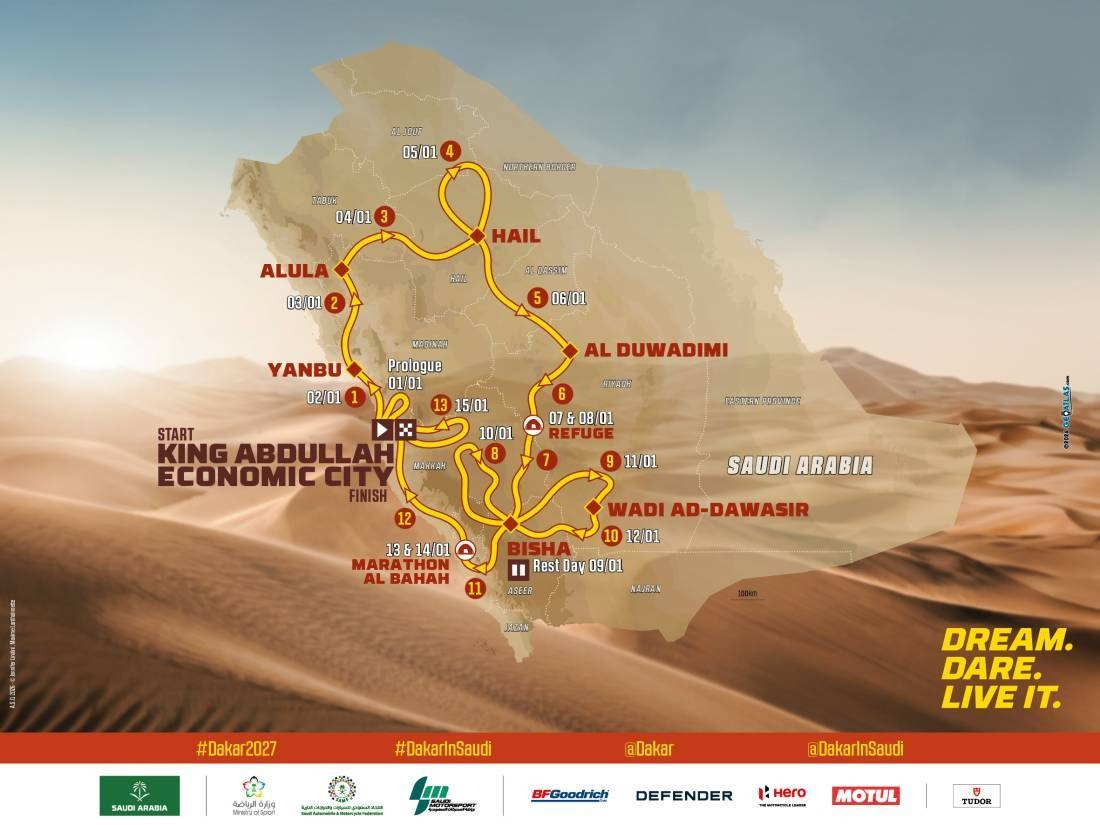
Prologue01/01/2027King Abdullah Economic City · Start
Stage 102/01Yanbu
Stage 203/01AlUla
Stage 304/01Tabuk / Hail
Stage 405/01Al Jouf · Northern border
Stage 506/01Hail → Al Duwadimi
Stage 6–707–08/01Refuge · Marathon stage
Rest Day09/01Bisha · Rest day
Stage 810/01Towards Bisha
Stage 911/01Wadi Ad-Dawasir
Stage 1012/01Wadi Ad-Dawasir
Stage 13–1413–14/01Marathon stage · Al Bahah
Finish15/01King Abdullah Economic City · Finish
Route map Dakar Classic 2027 in Saudi Arabia
Route map · Dakar Classic 2027 Saudi Arabia · 15 stages 01 – 15 January 2027 · King Abdullah Economic City
Regulation 2027

The 2027 Technical Regulation of the Dakar Classic has been updated by the ASO. Three changes compared to the previous year: 2 adjustments to mandatory safety equipment, 1 change concerning the mounting of the navigation instruments. Vehicles admitted: built before the year 2005.

Regulation & PDF
FAQ

The most common questions.

Do I need motorsport experience?

Basic driving experience is helpful. Anyone with prior offroad or rally experience will settle in faster. But the Dakar Classic is not a race for speed. It tests navigation, reliability and stamina. Our team prepares you and supports you on every stage.

What is the difference between Dakar and Dakar Classic?

The Dakar Rally is a speed race for state-of-the-art racing vehicles. The Dakar Classic is a regularity and navigation rally for historic vehicles built before 2005. Precision, navigation and reliability decide. Not maximum engine power.

What is included in a DELTA driver seat?

Driver seat including co-driver, fully built Puch GE280 to Dakar Classic regulations, experienced mechanic team, MAN 6×6 service truck (stage approved), MULE race container, bivouac service, spare-parts and tool supply 24/7, complete ASO entry, customs handling, visa procurement and on-site logistics.

How does the entry process work?

We take care of the complete ASO entry, customs handling, visa procurement and all administrative processes. From the first submission to technical scrutineering in Barcelona. You focus on driving.

What happens in case of a technical failure on the track?

Our support team stands ready to help in case of emergency. Whether that means technical support or recovering the race vehicles, we get you back to the service park. Our spare-parts vehicle and fleet are ready 24/7.

Which vehicles are admitted to the Dakar Classic?

Vehicles built before 2005 and homologated according to ASO regulations. Our Puch GE280 is one of the most iconic vehicles in Dakar history. We are happy to advise you on your own vehicle as well.

How far in advance do I have to book?

As early as possible. Driver seats and service slots are limited. Experience has shown that the most attractive seats are taken more than a year before the start.

Request a driver seat